Faber Castell Pitt Dual Ended Markers Colors and Review

When I first saw the Pitt Artist Dual markers I knew that I wanted to get them. The marker features a dual tip, a brush nib and a fine point .8mm. The colors are super vibrant. One of the coolest things about these markers is they are lightfast, unlike most markers because they use India Ink. They are odorless and they do not bleed through pages. They are also super juicy and acid free. 

This blog post contains affiliate links.


Here are all the colors and examples of both tips. This swatch book was provided by Coloring Bliss. The *** are the best light fast and * is the worst for lightfastness. I wish these came in more colors for sure.

Here is some lettering I did with these markers. I love how the color came out different based on the pressure I was using. the little splotches on the page was because I accidently got a splotch on the page an then I did it intentionally on the page.


Here is some more lettering I did with these. I tried to blend them. I think I could practice that a bit more.


Here was a prompt I got from the Moriah Elizabeth Create This book. It is definitely interesting.


I made this in honor of Taylor Swift getting all her masters for her albums back.

Color Information:

Here are the colors for the Faber Castell Pitt Artist Pen Dual Marker: Green gold 268**, Cinnamon 189***, Beige red 132**, Sanguine 188***, Raw Umber 180***, India red 192***, Dark Sepia 175***, Cold grey III 232***, Warm Grey III 272***, Black 199***,  Leaf green 112**, May green 170***, Light yellow glaze 104*, Cadmium yellow 107***, Dark chrome yellow 109***, Orange glaze 113***, Scarlet red 118***, Coral 131***, Deep Scarlet Red 219***,  Middle purple pink 125***, Purple violet 136***, Skyblue 146**, Ultramarine 120***, Ice blue 148**, Phthalo blue 110***, Light cobalt turquoise 154***, Phthalo green 161***, Dark phthalo green 264**, chromium green opaque 174***, Permanent green olive 167**



Read More »

Faber Castell Watercolor Markers Demonstration and Review

I love anything Faber-Castell makes. They have really good products even if they are very expensive. The best thing about these watercolor markers is they are lightfast. Not many markers are light fast. The colors are super vibrant and there is a ton of ink that can be drawn out from one marking on the paper. The markers come with two tips a brush and a thin line marker. There are only 30 colors, but most of them are unique and they can be combined to make more colors.

This blog post contains affiliate links.
 

The markers can be used three ways as illustrated below. They can be drawn on a different surface and then painted on. The markers can be used as straight markers, but that is super bold. I would use them sparingly when doing that. Or then can be drawn on the surface and then spread. I like C the best below, drawn on the surface and then spread, but I also like A a lot also.


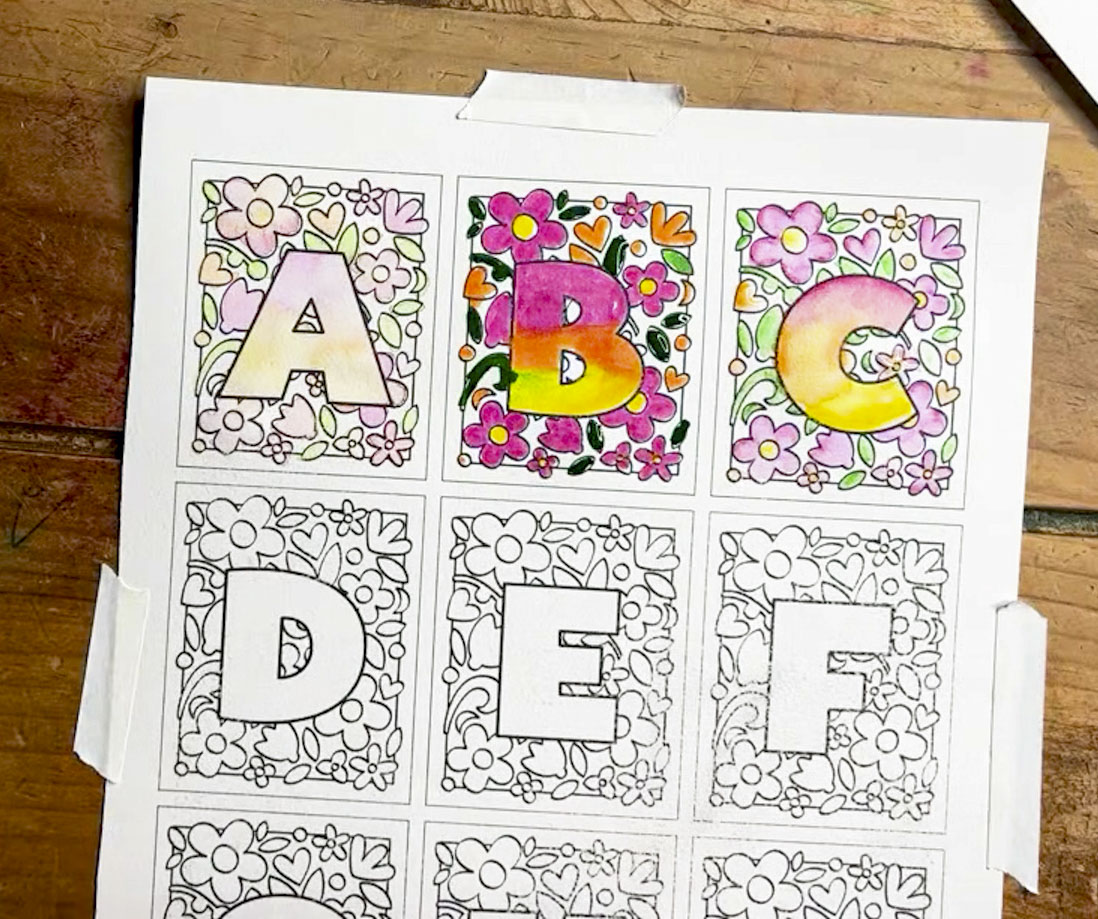
Here are the song titles to Taylor Swifts 1989 (Taylor's Version) I did in watercolor. I drew the color on a Yasutomo dish and then used a water brush to spread the color.


What is really cool is because Faber-Castell has the same color system for all their supplies the markers can be used with the pencils. All You Had to Do Was Stay shadows were made with pencil while I wish You Would and Wildest Dreams were made with the fine tip of the watercolor marker.


Here is the front of the box.

 Color Information

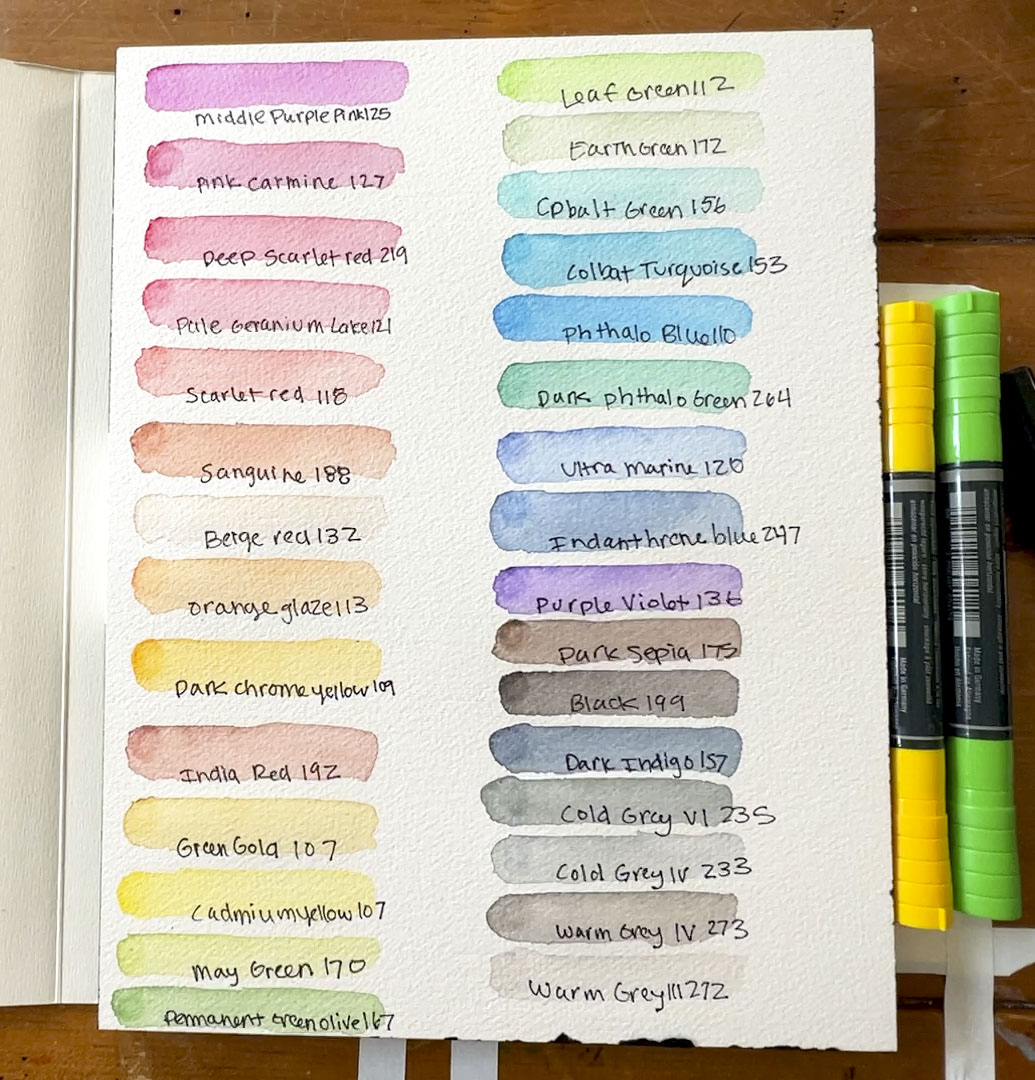
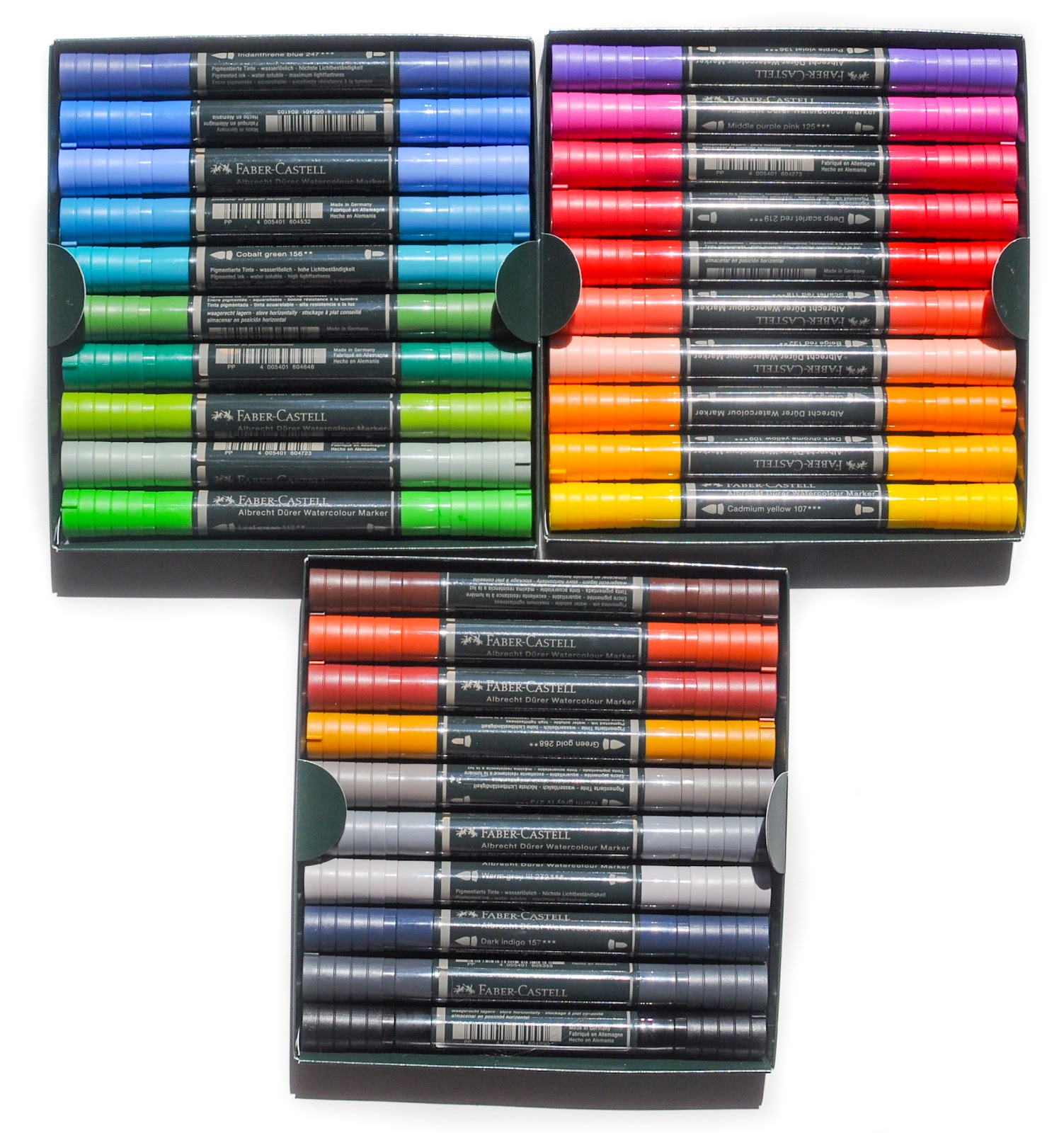
Here are all the colors in the box. Each marker contains a color number.

What's inside the box: 

  • Middle purple pink 125***
  • Pink carmine 127***
  • Deep scarlet red 219***
  • Pale geranium lake 121***
  • India red 192***
  • Scarlet red 118***
  • Sanguine 188***
  • Beige red 132***
  • Orange glaze 113***
  • Dar chrome yellow 109***
  • Green gold 268***
  • Cadmium yellow 107***
  • May green 170***
  • Permanent green olive 167***
  • Leaf green 112***
  • Earth green 172***
  • Dark phthalo green 264***
  • Cobalt green 156***
  • Cobalt turquoise 153***
  • Phthalo blue 110***
  • Ultramarine 120***
  • Indanthrene blue 247***
  • Purple violet 136***
  • Dark sepia 175***
  • Black 199***
  • Dark Indigo 157***
  • Cold grey VI 235***
  • Cold grey IV 233***
  • Warm grey III 272***
  • Warm grey IV 273***


Collecting Information
Boxes: 30 Faber-Castell Albrecht Durer Watercolour Markers
Year: unknown
Purchase Information: Blick
Where to buy: Blick
Part Number: 100-115-942 16 03 30
UPC: 4005401603306
Manufacturing Location: Germany

Here is the back, inside and side of the box.


Read More »

10 Ways to Blend Colored Pencils with 7 Different Colored Pencils

Colored Pencil Blending...it was something I wanted to do a deep dive into, I even bought all the supplies for it a year ago, but never got around to it. But in the beginning of 2022 I knew I wanted to give it a go. I created a chart, grabbed all the colored pencils I wanted to try and pulled out all of the different blenders I had collected. The results I found were super interesting.

This blog post contains affiliate links.


10 Different Ways to Blend

10 Different ways of blending colored pencils include:

Wax Vs Oil Based Colored pencils
The different colored pencils will blend differently because the colored pencils are comprised of different materials. A colored pencil can either be wax or oil based. 

Wax based colored pencils use wax to bind with the pigment and then are encased in wood. They are generally softer than oil based colored pencils and blend really well if the wax is high quality. This also means the wax based colored pencils will break more easily. Wax based colored pencils are also more prone to blooming, ie when the wax comes out of the pencil and appears as a white film on the colored pencil lead. 

Oil based colored pencils use oil to bind with the pigment of the colored pencil and are also encased in wood. Oil based pencils are usually the more professional art supply because they create a more polished look than the wax based colored pencils.

It seems to be a secret which colored pencils are wax based and which are oil based. It is not directly advertised on the packaging.

For the colored pencils I used in this experiment the following pencils were wax based
The following pencils were oil based:
10 Blending Methods Explained and Tested

Here are the results with each method explained. I tested these all on Neenah Bristol Cardstock, which is not super toothy but enough so to really get the pigments out of these pencils. The results vary depending on how well the blender was able to mix with the colored pencils. I will warn that using anything other than the blending methods provided by a company may reduce the lightfastness of the colored pencils.

To see me testing each method watch the YouTube video or scroll on to see the results.


Each of these blending methods produces different results and more than one can be used in a drawing or coloring piece.

Layering is putting down one light color at a time. It is the basis for all of the methods below. There is no pushing hard in this method.
Burnishing starts by layering each colored pencil lightly and then at the very end pushing down really hard with each color on the final layers. The colors become very saturated and dark.

Burnishing with white starts with the layering method and then instead of burnishing with the original colors a white pencil is used. This creates a pastel blend. A lighter color other than white such as gray or another lighter base color could be used also with this method.

The next three blending methods use a colorless blender approach. The colorless blender is applied like a pencil and blends the colored pencil by mixing and unifying colors together. Some colored pencils are easier to blend than others, but for the most part the Caran d'ache did the best job.

Caran d'ache full blender blending starts with the layering method and then uses a colorless blender over the original pigments to bring out the pigments, fill in the white spaces and mix the colors together. This results in a blend that is lighter than the burnishing method, but still very saturated. The Caran d'ache blender was my favorite blender stick or pencil to use. It is not encased in wood, but can be sharpened like a pencil. I have researched and it also comes in a pencil form or just as a full stick. It does say in the product description that the blender will improve lightfastness.
Lyra Splender blending starts with the layering method and then uses a colorless blender to bring out the pigments, fill in the white spaces and mix the colors together. I found that this method left a lot of flakes on my drawing.
Prismacolor Colorless Blender blending starts with the layering method and then uses a colorless blender to bring out the pigments, fill in the white spaces and mix the colors together. This method was most similary to the Lyra Splender. It left a lot of flakes behind and was not as smooth.
Finese Pen blending is basically blending with an alcohol based marker that is packaged as a blending pen. Any alcohol based marker will do. The method starts the same with the layering step and then the finese blending pen lays down alcohol onto the drawing. It blends the colors together as the alcohol binds with colored pencil solution.
Meltz from Holbein Colored Pencil Blender is a blender intended for use with oil-based colored pencils. It is best applied with a brush and crates a watercolor effect for colored oil-based colored pencils. I used this on different colored pencils with various results. It worked best on Holbein Colored Pencils and Polychromos colored pencils. The Meltz comes with a warning not to inhale but does have the AP symbol on it meaning it is safe to use.
Baby Oil can be used with a brush or q-tip over colored pencils to blend colors together and create a watercolor effect with colored pencils. I initially tried this method because Polychromos suggested it in their packaging. I almost did not do it because I did not have any baby oil on hand. The baby oil blending method for blending colored pencils worked better than the Holbein Meltz did. And I liked it too because there were not any unknown chemicals I was putting down on the paper.
Brush and Pencil Colored Pencil Powder is a powder that is preapplied to a surface in order to achieve a blend. It is very messy and a method I would not recommend because there are plenty of other methods that produce easier results with less mess. It is hard to control where the powder goes and may land in places blender is not wanted. I am glad I tried it, but I will not use it often.
Results

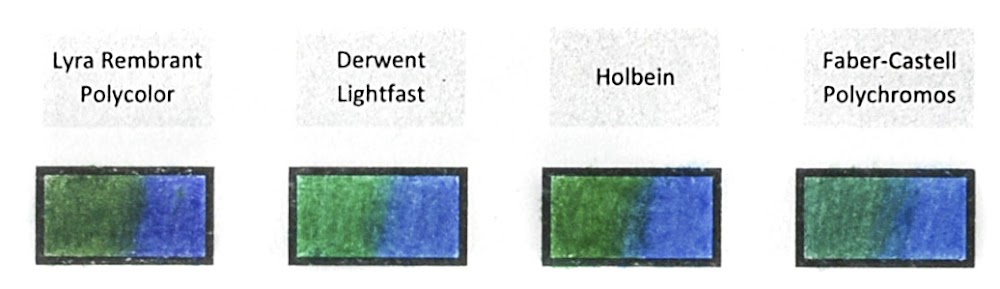
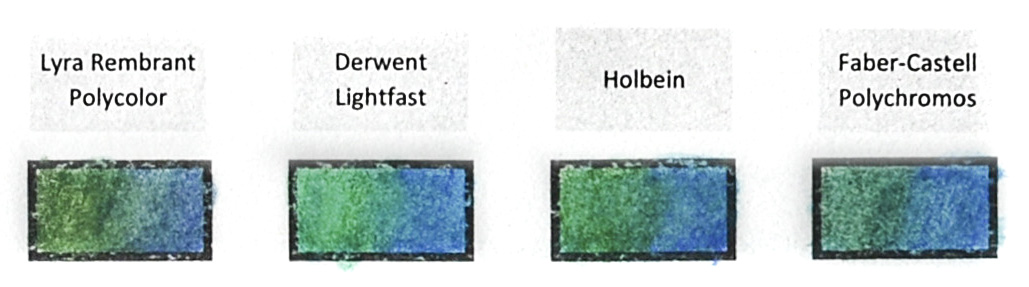
All the blending methods produced different results depending on the colored pencil used. The pencils that performed the best for blending in my opinion were the Faber-Castell Polychromos colored pencils. The ones that performed the worst were the Faber-Castell Goldfaber colored pencils. The Crayola blended a lot easier than the Goldfaber. Prismacolor Premier colored pencils performed the best of the wax based colored pencils.

Read More »

36 Polychromos Faber-Castell Colour Pencils

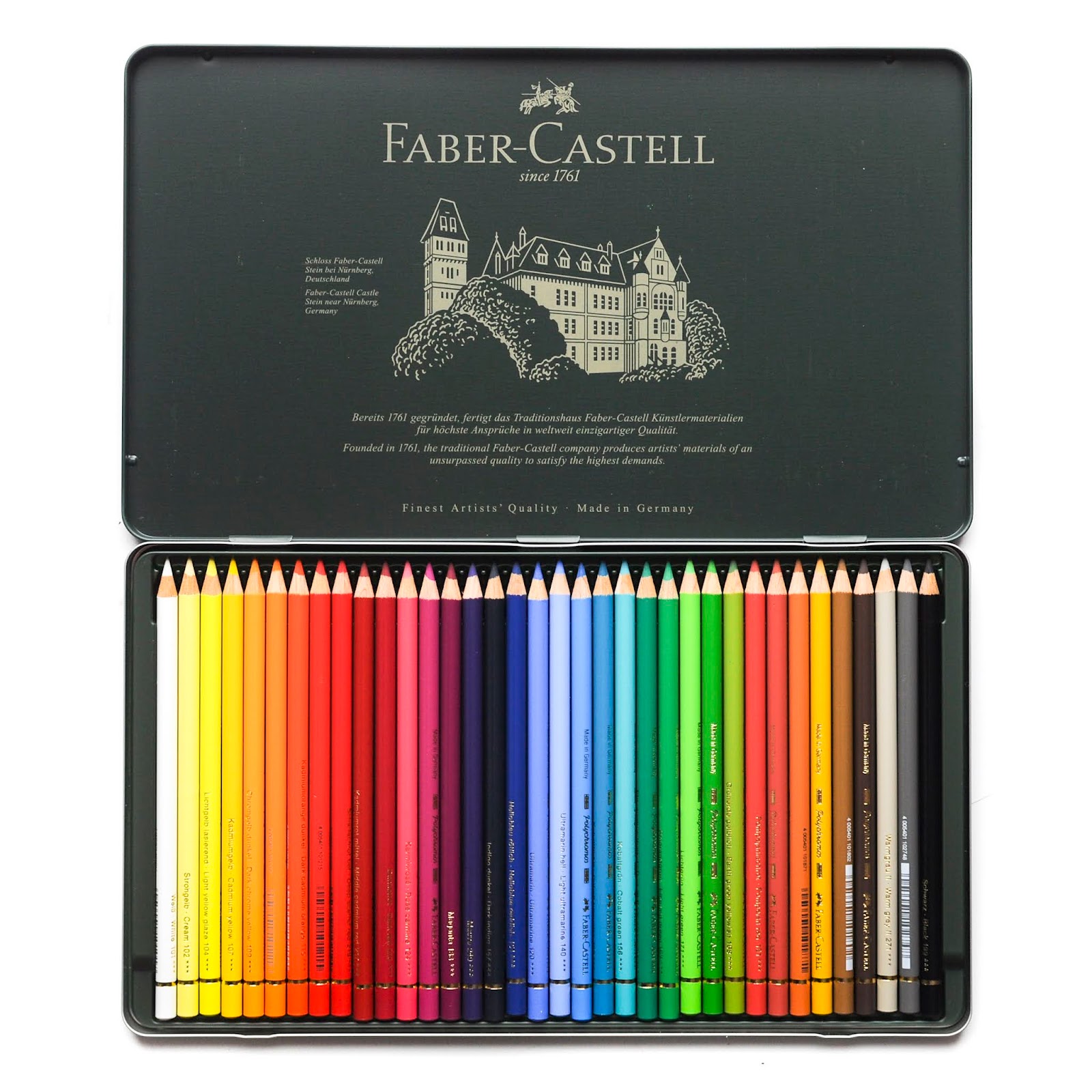
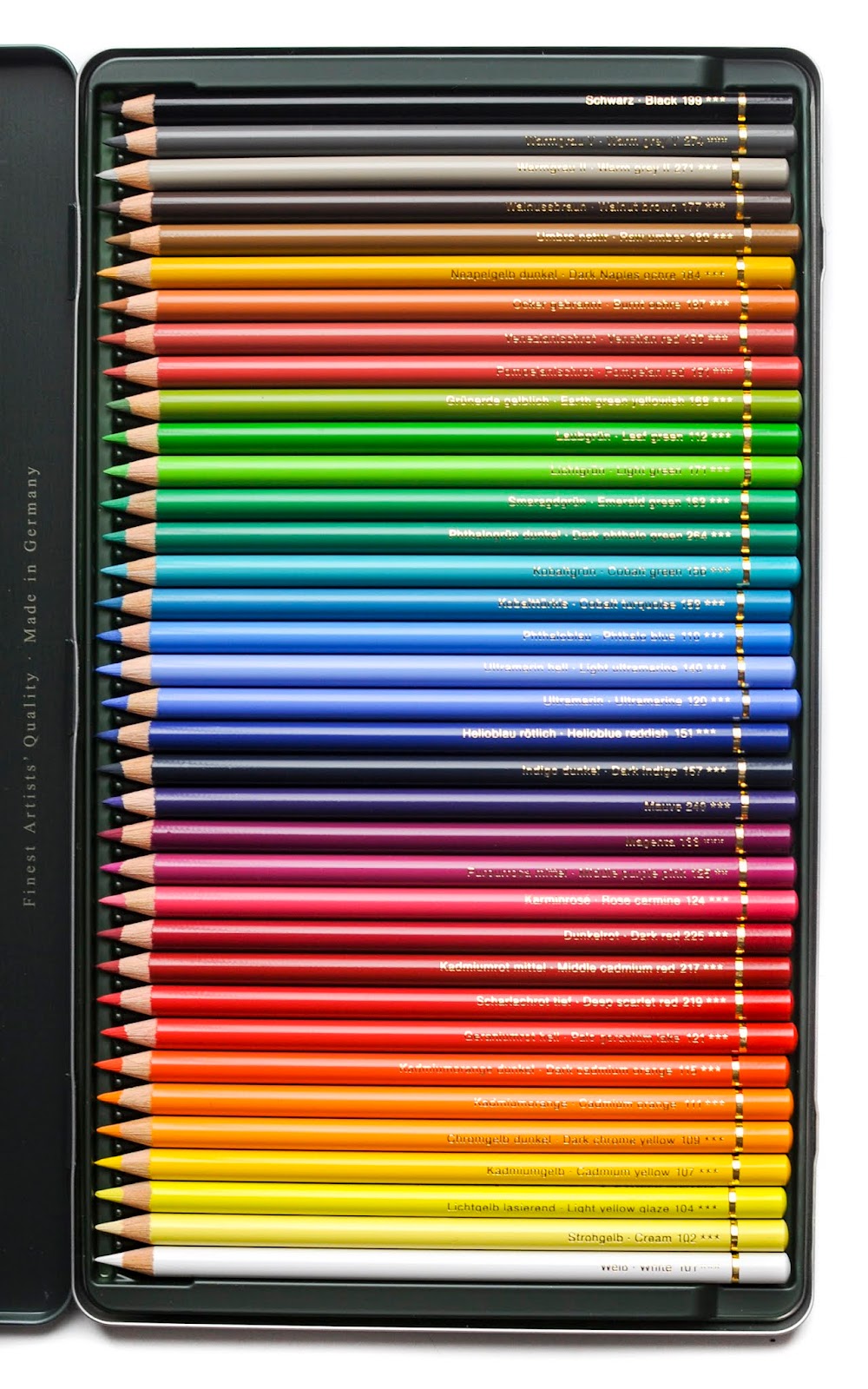
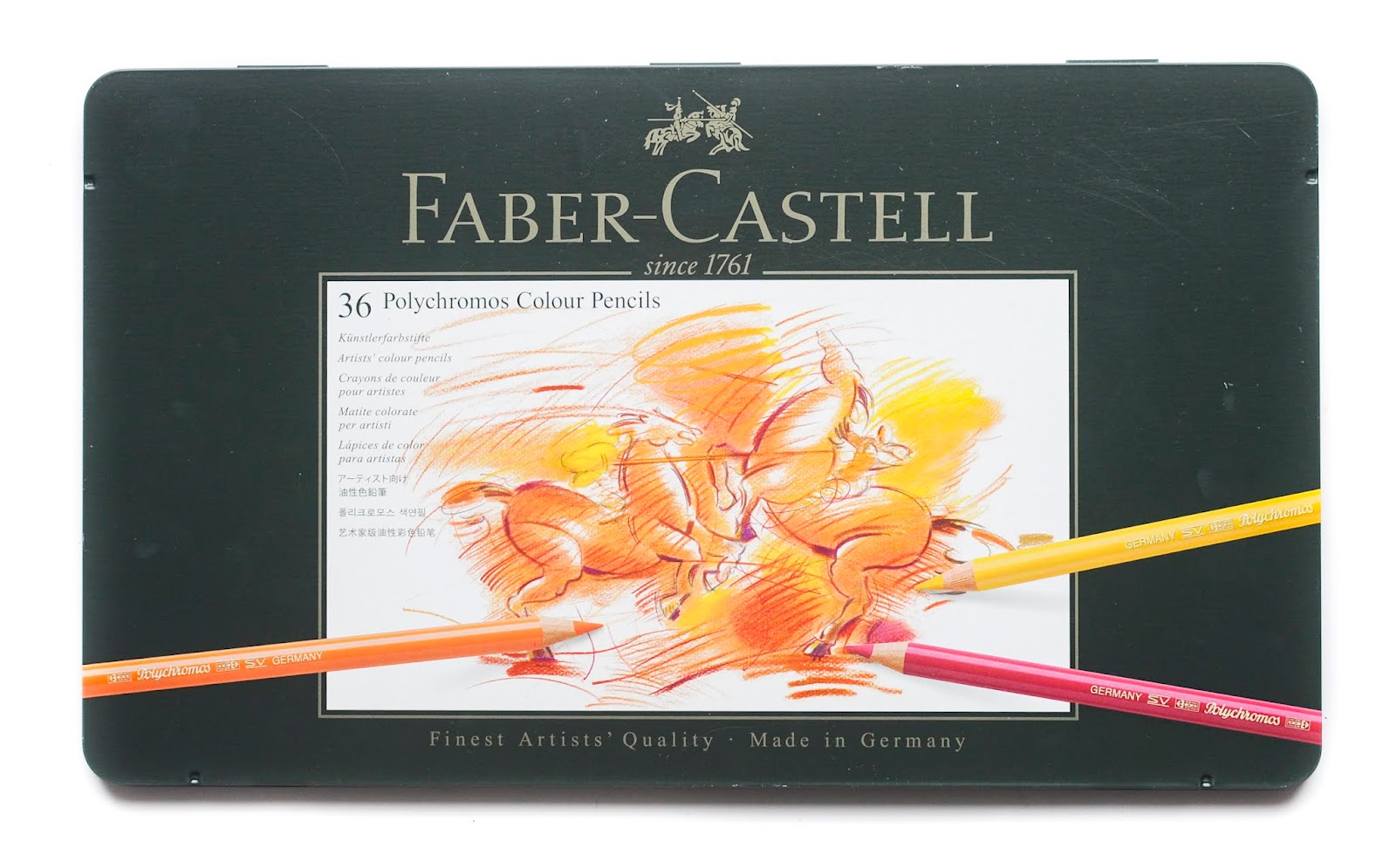
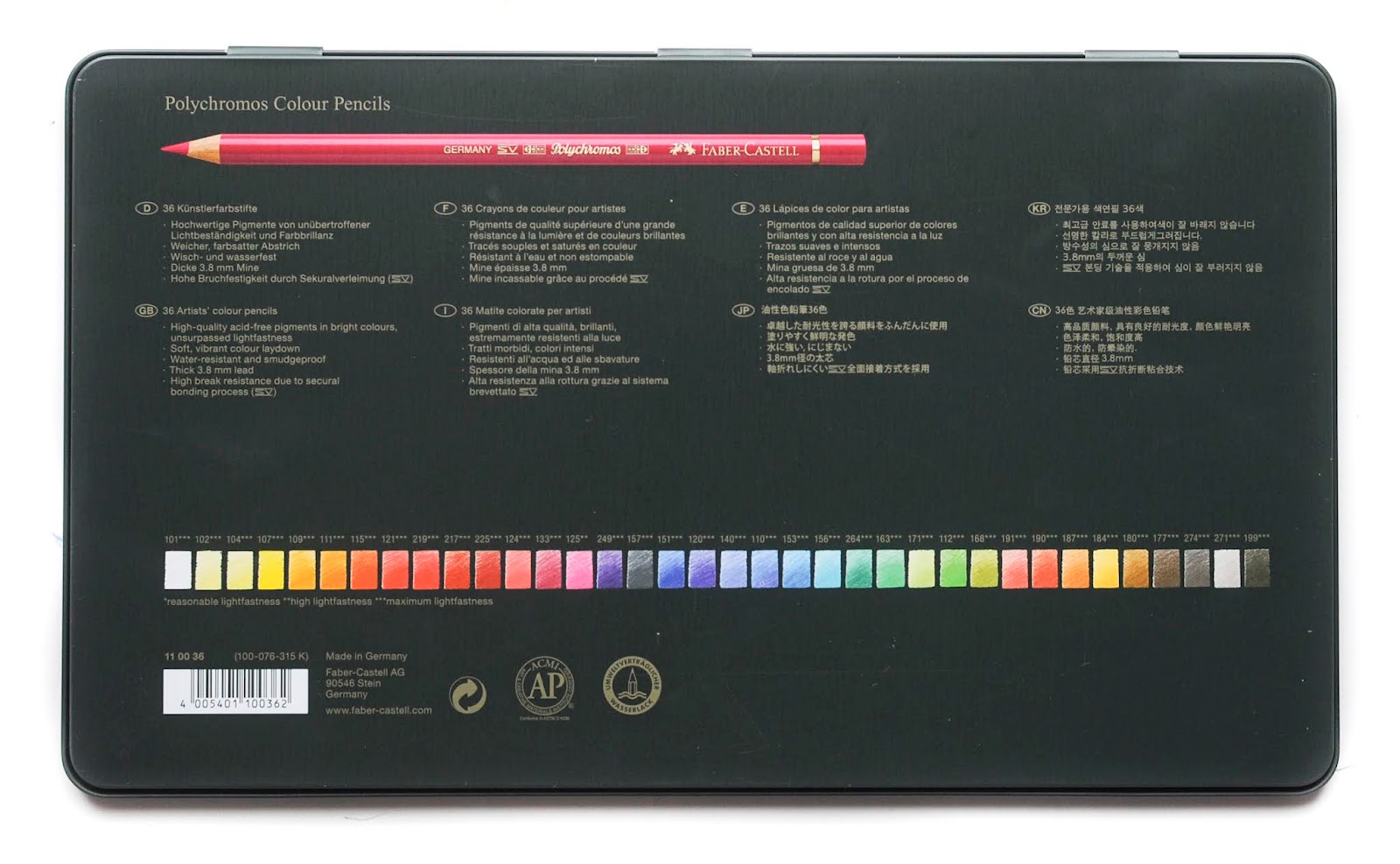
I am super excited to share the 36 Polychromos Colour Pencil box today. This box contains a super pretty color palette and is much more affordable than the bigger 120 count box. It comes in a pretty tin much like the larger tin with a removable pencil tray. The colors are all named and numbered with individual barcodes on the pencil. On the back there is a swatch chart and characteristics of the pencils.

 Color Information

Here are all the colors in the box. Each marker contains a color number.

What's inside the box: 

  • Black (199)***
  • Warm Grey V (274)***
  • Warm Grey II (271)***
  • Walnut brown (177)***
  • Raw Umber (180)***
  • Dark Naples ochre (184)***
  • Burnt ochre (187)***
  • Venetian red (190)***
  • Pompeian red (191)***
  • Earth green yellowish (168)***
  • Light green (171)***
  • Leaf green (112)***
  • Emerald green (163)***
  • Dark phthalo green (264)***
  • Cobalt green (156)***
  • Cobalt turquoise (153)***
  • Phthalo blue (110)***
  • Light ultramarine (140)***
  • Ultramarine (120)***
  • Helioblue reddish (151)***
  • Dark indigo (157)***
  • Mauve (249)***
  • Magenta (133)***
  • Middle purple pink (125)***
  • Rose carmine (124)***
  • Dark red (225)***
  • Middle cadmium red (217)***
  • Deep scarlet red (219)***
  • Pale geranium lake (121)***
  • Dark cadmium orange (115)***
  • Cadmium orange (111)***
  • Dark chrome yellow (109)***
  • Cadmium yellow (107)***
  • Light yellow glaze (104)***
  • Cream (102)***
  • White (101)***
Where to buy: Blick Art Supplies

Collecting Information
Boxes: 36 Faber-Castell Polychromos Colour Pencils
Year: unknown
Purchase Information: received from Faber-Castell
Where to buy: Dick Blick Art Materials 
Part Number: 11 00 36, 10-076-315 K
UPC: 4005411003662
Manufacturing Location: Germany

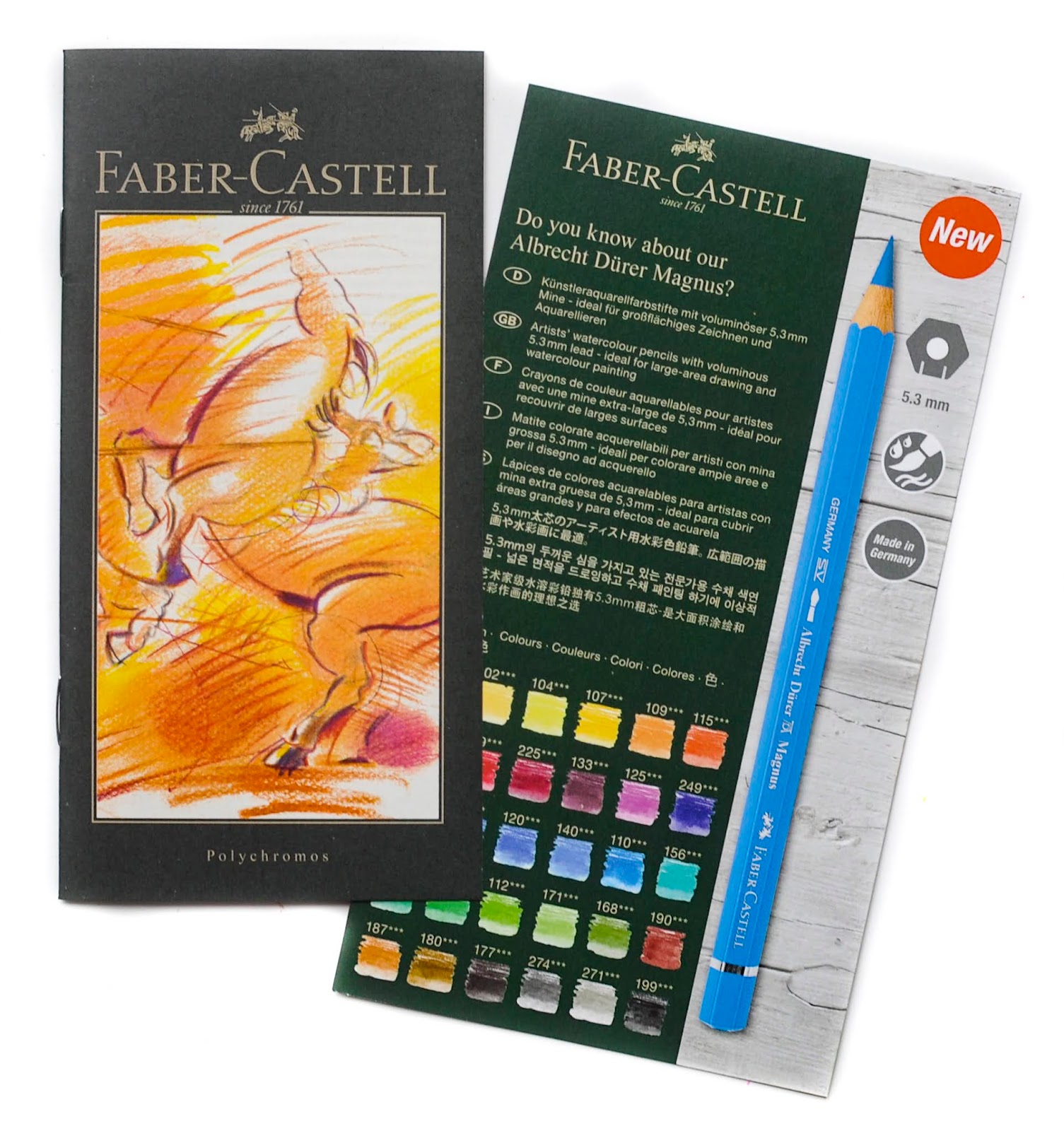
Here is the front, back and extra materials that come in the box.


Read More »

Faber-Castell 48 Goldfaber Regular and Aqua Colored Pencils Review

I recently found out there are other lines for Faber-Castell besides Polychromos at Creativation/Art Materials World this year. I went to Creativation to meet especially with Faber-Castell because I love their color system. They were my first meeting and they did not disappoint. They were so nice. They explained to me there are three current lines, the green line for professional artists, the blue line for hobbyists and students and the red line for kids. They sent me these Goldfaber aqua and regular colored pencils to try out. And I did try them out. And guess what? I was SUPER IMPRESSED. The colored pencils were super easy to color with, the colors were super vibrant and then even match the Polychromos color line.

This blog post contains affiliate links.Click here to find these pencils on Blick Art Supplies. 

These are a very affordable option. I looked on blick and the 48 colors were about 33 dollars. The only disappointment was the line only comes in 48 colors. I wish they had all 120 colors. I want to repeat again these were easy to color with, ie my hand did not hurt after I colored with them.

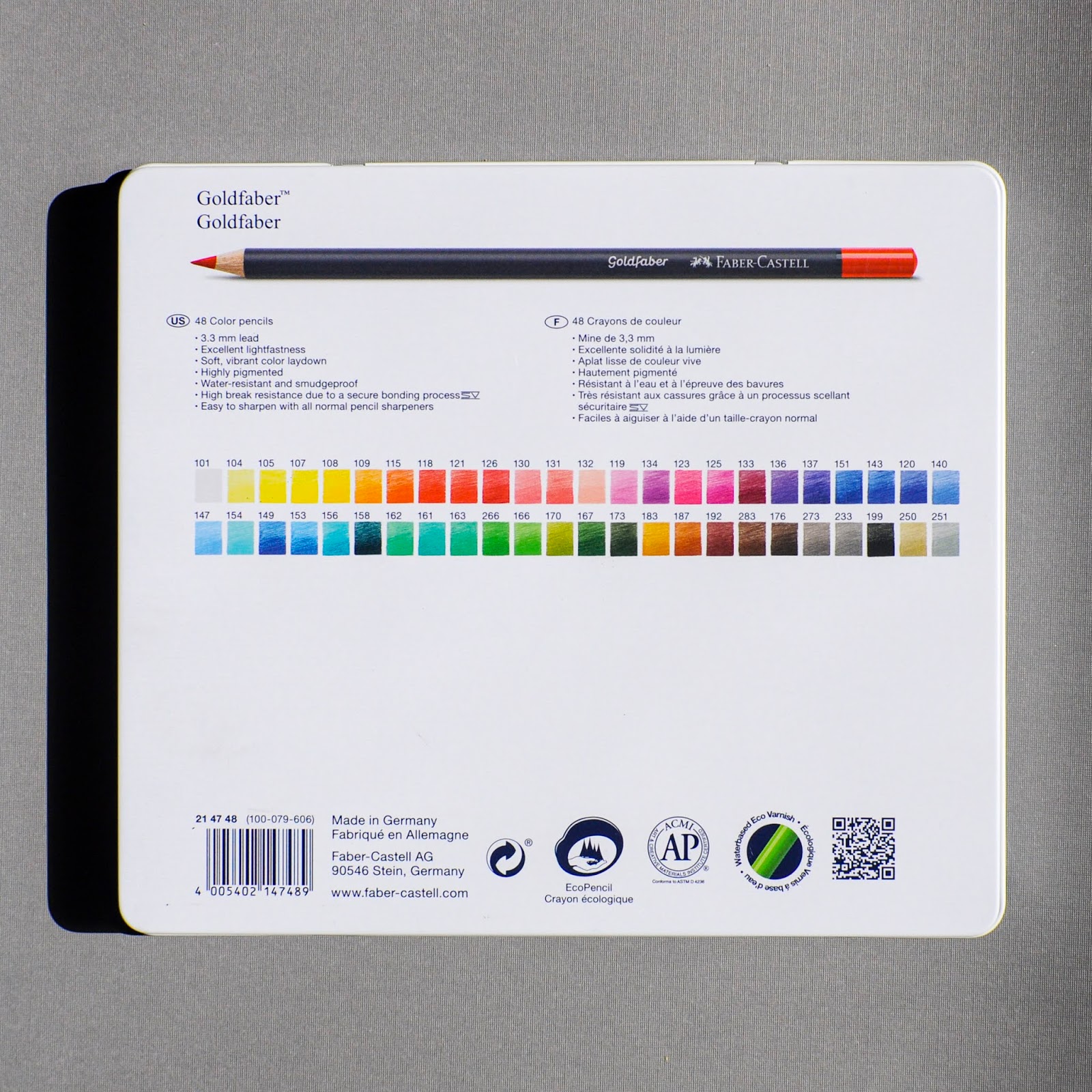
Other attributes from the back of the box include: 3.3 mm lead, excellent lightfastness, highly pigmented, water resistant for the smudge proof for the regular colored pencils, high break resistance and easy to sharpen.

These are the swatches for the 48 Goldfaber Aqua colored pencils. I only activated the watercolor in half the swatch to see what it looks like with out the watercolor. I absolutely love the color palette. It is bright and colorful.

Here are the Goldfaber colored pencils on bamboo paper. I love the gradients that are possible from the colored pencils.

Here are the colors in the Goldfaber line. They are the same in box boxes:

  • 136, 133, 125, 123, 134, 119, 132, 131, 130, 126, 121, 118, 115, 109, 108, 107, 105, 104, 173, 167, 170, 166, 266, 163, 161, 162, 158, 156, 153, 149, 154, 147, 140, 120, 143, 151, 137, 199, 233, 273, 176, 283, 192, 187, 183, 250, 251

Here is the case for the colored pencils. The pencils are all individually skewed. They are also sold open stock. The color names are not on the pencil, but the color number is and that corresponds to the Faber-Castell color system. I love the detail in the tray that is also found in the Polychromos line. See those straps? It is made that way so the pencil trays will easily come out. These are the watercolor pencils.Here are the regular colored pencils. They are very similar except the wood color is black. That is nice so the aqua and regular pencils will not get confused with one another.

Here is what the pencils look like on black paper.

I also created a swatch chart for the colored pencils. Click here to get the chart.


I would definitely purchase these and will have my kids use them. They absolutely love my colored pencil collection :)

Find these on Blick Art Supplies.

Here is the packaging information for the colored pencils. It does note not to dip the colored pencil in water.Here is the packaging information for the regular colored pencils.Here is the inside of the tin featuring the Faber-Castell Castle Stein near Nurnberg, Germany.

Read More »